

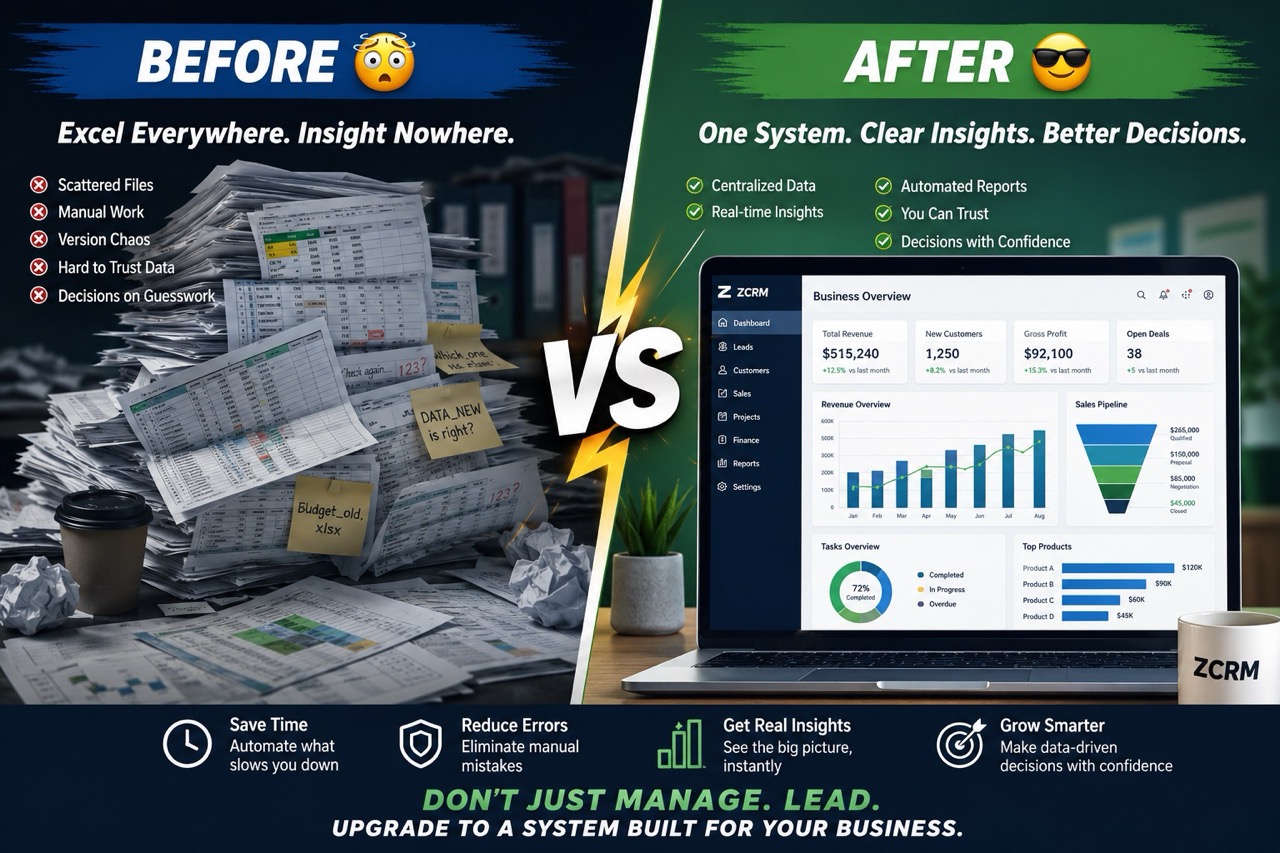
Most small and medium businesses don’t set out to build their operations on spreadsheets and email threads. It just happens gradually – one tracking sheet here, a shared inbox there – until one day the whole company is quietly held together by files named „Orders_FINAL_v3_reallyfinal.xlsx.”
That’s not a failure on anyone’s part. Spreadsheets are genuinely good tools, right up until the moment a business outgrows them. The hard part is noticing when that moment has arrived, because the transition is rarely dramatic – it’s a slow accumulation of small frictions that eventually add up to real cost.
Here are five signs that the shift has already happened, even if it doesn’t feel that way yet.
1. Nobody is sure which file is the current one
If your team has ever spent ten minutes in a group chat trying to work out whether „Orders_v3” or „Orders_v3_updated” is the real one, this is already costing you. Every version-naming convention is really just a manual, error-prone substitute for something a proper system does automatically: a single source of truth that everyone opens at once.
2. Customers call to ask about their own order
When a client has to phone or email you to find out where their order stands, that’s a signal worth paying attention to. It means the information exists somewhere in your business, but not somewhere the customer can reach. A simple client portal – even a very basic one – removes an entire category of interruptions from your day, and often makes customers feel more in control at the same time.
3. Institutional knowledge lives in people’s heads, not in your systems
Ask yourself: if your most experienced employee took two weeks off unexpectedly, would anything grind to a halt? If pricing exceptions, client quirks, or „how we’ve always handled this” only exist as tribal knowledge, your business has a single point of failure that a spreadsheet was never designed to protect against.
4. Reporting means someone manually copying numbers between files
If getting a simple answer – how many orders shipped last month, which clients haven’t paid, what’s overdue – requires opening three files and doing some manual arithmetic, you’re paying a recurring tax on every question your business asks itself. That tax compounds as the company grows.
5. Growth feels like it’s adding friction, not easing it
This is the clearest signal of all. In a healthy system, taking on ten more clients should mostly mean doing more of the same work. If instead it means more chaos, more mistakes, and more time spent just keeping track of things, the tools underneath your business have stopped scaling with it.
What this doesn’t mean
None of this means you need an expensive, months-long ERP rollout. Most businesses that recognize themselves in the list above need something much smaller than they assume: a simple, purpose-built application that replaces the two or three spreadsheets doing the most damage – orders, client records, or a shipping schedule – with one place everyone can see and trust.
That’s usually a project measured in weeks, not quarters, and it’s worth sizing up before assuming it’s out of reach.
If any of these signs sound familiar, it’s worth a short conversation to see whether your specific process could become a simple, working application – often faster and more affordably than expected.
