
Connect manufacturing operations, materials, purchasing, production, quality and finance through a system built around the way a factory works.
Manufacturing ERP is one of our Ready Applications. It connects the main manufacturing and administrative workflows in a single system and follows the relationships between departments instead of treating each one as a separate tool.
Manufacturing businesses coordinate a large number of interdependent activities. Customer orders create demand. Demand influences purchasing and production planning. Materials move between warehouses, production stages and subcontractors. Quality checks, delivery schedules, costs and approvals all affect the final result.
When these activities are managed in separate spreadsheets and disconnected applications, information becomes difficult to reconcile and teams can lose sight of the overall process.
Manufacturing ERP is an extensive business application developed to connect key manufacturing and administrative workflows in one system. Its structure covers the operational cycle from product and material records through procurement, production, inventory, dispatch, finance and supporting business processes.
It is an example of how a complex, process-driven application can be built to reflect the relationships between departments rather than treating every department as a separate system.
Product data, variants and bills of materials
Manufacturing starts with a clear definition of what the business makes and what is needed to make it.
The application includes product and product-variant records, product categories and types, units of measure, brands and related attributes. It also includes a Bill of Materials (BOM) module.
BOM records can contain material details, operational costs, other costs, operation time, material cost, total cost, product variants and units of measure. The application also includes product-development and engineering-change records, including NPD-related processes and ECN requests.
These capabilities provide a structured foundation for managing product definitions, material requirements and cost information associated with production.
Procurement and supplier management
Purchasing is connected to production needs, stock availability, suppliers and approval procedures. Manufacturing ERP includes purchasing and procurement records such as:
- Purchase requests and purchase orders
- Direct purchase orders
- Requests for quotation and vendor quotations
- Vendor and product records
- Purchase planning details
- Purchase-order approvals and rejections
- Goods received notes and related receiving details
- Supplier assessments and vendor ratings
- Purchase-related cost-centre information
The application includes configurable approval structures for different request types and roles. Approval workflows can involve employees, managers, finance and procurement teams, depending on the process being configured.
This makes it possible to organize purchasing as a controlled business process rather than a sequence of disconnected documents.
Inventory, batches and warehouse operations
Inventory management requires more than a single quantity field. Businesses may need to know which materials are available, where they are stored, which batch they belong to and whether stock has been issued, relocated, adjusted or reserved for a particular activity.
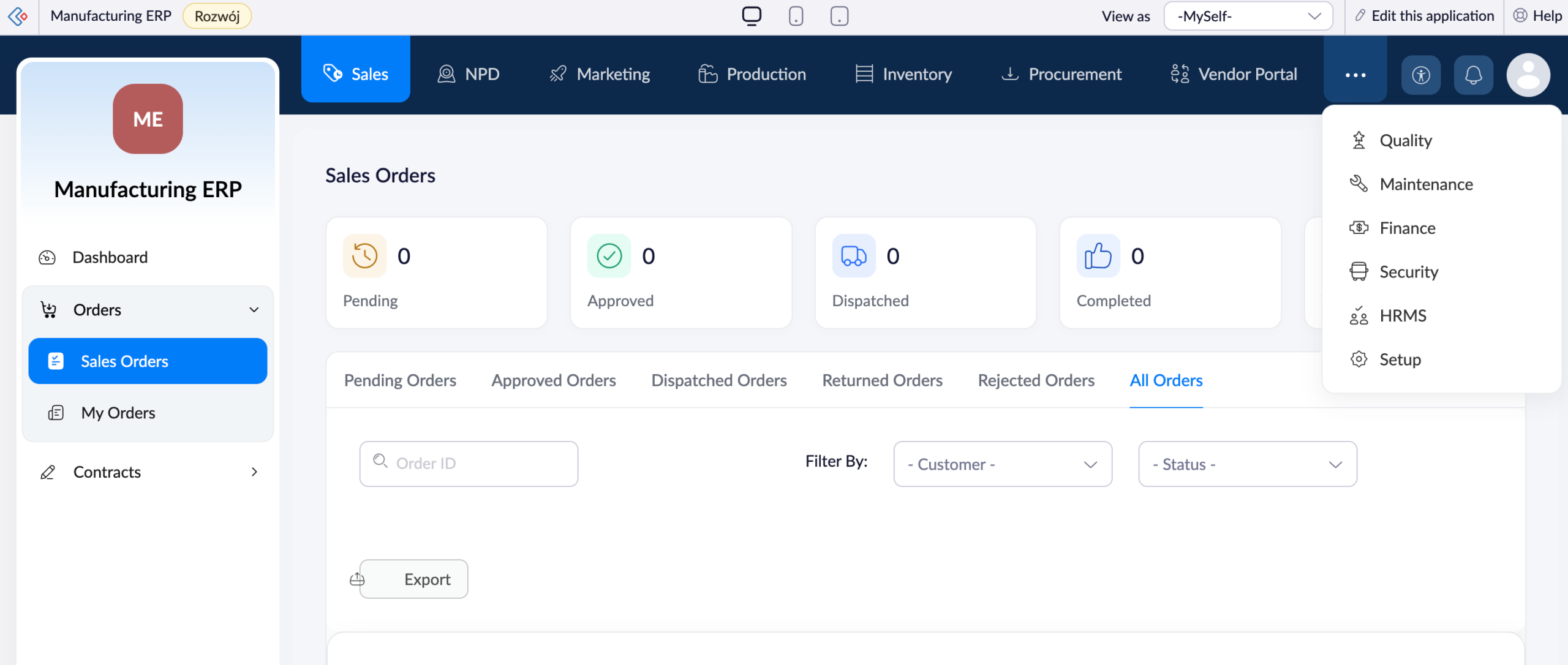
Manufacturing ERP includes stock records, batch search and batch details, warehouse and storage-space records, storage units, racks, stock takes, stock adjustments, stock relocation and material issuance.
The application also contains functionality related to batch-level quantities, allocated and available quantities, issued and relocated quantities, scrap status and stock-take history.
These records support more structured inventory control and help connect material movements with warehouse and production operations. The exact inventory rules and tracking requirements should be confirmed for each implementation.
Production orders, work orders and shop-floor operations
The production-related modules connect manufacturing work with the materials, operations and workstations involved.
The application includes production orders, production job orders, work orders, daily and monthly production planning records, workstations, work-item outputs and assignment of work orders to workstations. It also includes records for in-house and outsourced job orders.
Production dashboards provide a dedicated view of production-related information. Additional records support work-order completion, subcontractor operations, material issues and returns, and production-related planning.
This structure can provide a common place to follow production activities and their related records, while allowing the implementation to reflect the customer’s actual production stages and responsibilities.
Quality control and non-conformance handling
Quality problems can affect stock, production schedules, suppliers and customer deliveries. Manufacturing ERP includes quality-analysis records, quality checks, incoming job-order quality processes, purchase-order quality details, rejected products and return-material workflows.
The application also includes records for faulty material, breakdown reporting and remediation options. These functions provide a structured basis for recording issues, assessing materials and following up on exceptions.
Quality procedures differ significantly between industries. During implementation, the relevant inspection steps, acceptance criteria, responsibilities and records need to be aligned with the manufacturer’s requirements.
Sales orders, dispatch and delivery documentation
Manufacturing operations must connect production output with customer demand and delivery commitments.
The application includes sales inquiries, quotations, sales orders, order details, order verification, dispatch records, order payments, delivery challans and invoice and delivery-note records. It also includes order fill-rate records and related monthly reporting.
Dispatch documentation can capture invoice and order references, shipment type, dispatch timing and details, shipping charges, totals, attachments and related status information.
This supports a connected workflow from the commercial request through order processing and dispatch, with the exact sequence depending on the company’s configured process.
Finance, costs and accounting integration
Manufacturing ERP includes finance-related records such as chart of accounts, currencies, taxes, credit notes, debit notes, payment terms, expenses and cost centres.
Cost-centre information can be associated with purchasing and sales records. The application also contains integration configuration and functions for Zoho Books, including synchronization of relevant accounting and reference data and interactions involving customers, vendors and other records.
Integration availability and behavior depend on the connected Zoho Books organization, permissions, configuration and the specific processes enabled for the deployment.
The goal is to reduce unnecessary duplication between operational and accounting workflows while maintaining the links between transactions and the business activities that generated them.
Employee, maintenance and supporting operations
A manufacturing system also needs to support the people, equipment and internal services behind production.
The application includes employee records, departments, designations, skills, employee documents and training-related records. It also includes machine records, maintenance requests, preventive-maintenance information, maintenance history, spare-part usage and breakdown-related processes.
Other modules support projects, transport requests, trips, tools and tool issuance, office supplies, visitor logs and additional administrative workflows.
Not every manufacturer will need every module. The relevant scope should be selected according to the business’s size, operating model and existing systems.
Dashboards and role-based workflows
Manufacturing ERP includes dashboards for areas such as procurement, finance, production, inventory, sales, quality, maintenance, new product development and vendors.
The application also contains configurable approval levels and approval steps for several business processes. This allows workflows to reflect different roles and approval responsibilities rather than assuming that every transaction follows the same path.
The precise dashboards, permissions, approval rules and notifications should be configured and validated against the customer’s organization.
A starting point for a manufacturing ERP implementation
Manufacturing ERP is an implemented application with a broad set of connected modules. It can serve as a starting point for manufacturers looking for an integrated system covering several areas of their operation.
Potential applications include businesses that need to connect:
- Product definitions, variants and bills of materials
- Purchasing, suppliers and receiving
- Inventory, batches and warehouses
- Production orders, work orders and workstations
- Quality checks and material returns
- Sales orders, dispatch and delivery documents
- Finance, cost centres and accounting integration
- Employee, maintenance and supporting operational records
A system of this scope should not be treated as a universal, plug-and-play ERP that will fit every factory without changes. Before deployment, the existing application needs to be assessed against the target company’s processes, data structures, reporting needs, accounting practices, integrations and user permissions.
Depending on the requirements, implementation may involve configuring the existing modules, importing or migrating data, adapting workflows, testing business scenarios, connecting external systems and training users. Some businesses may need only a subset of the functionality; others may require additional development.
For a company whose processes align with the application, using this existing foundation can reduce the amount of work required compared with developing every module from scratch.
From operational complexity to a connected system
Manufacturing ERP illustrates a key principle behind custom business applications: the value is not simply in having many modules. It comes from connecting the records and decisions that move work through the business.
At 24hDeveloper, we build and adapt business applications around the processes companies actually use. We combine business-process experience with modern development methods to help turn complex workflows into working systems.
Need an ERP system for your manufacturing business? Contact 24hDeveloper to discuss your requirements and assess whether this manufacturing application can be adapted to your operation.
