
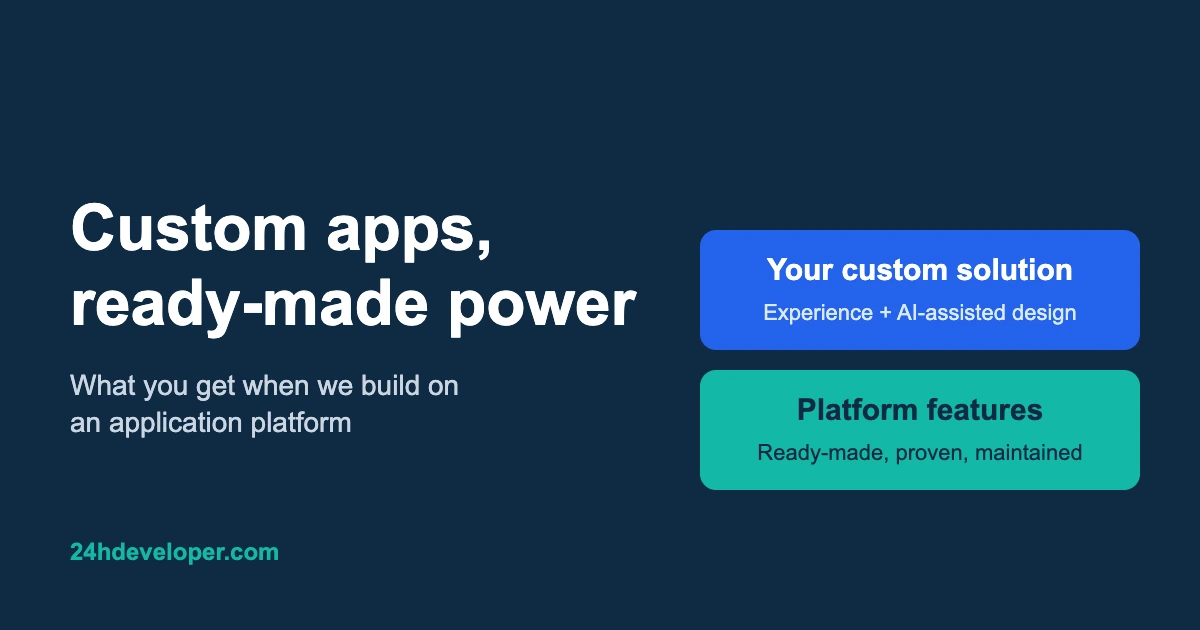
Every app we deliver has two layers: the part we design and build specifically for your business, and a large set of proven features that come ready-made with the platform it runs on.
Building software from scratch means paying for the same plumbing again and again: user accounts, permissions, forms, notifications, reports, hosting. We take a different route. We build your application on a mature application platform and spend our time on what is unique to your company. This post explains what that means for you and lists what you get “off the shelf” on top of the solution we create.
What we bring: experience and AI
The platform gives us the building blocks. What turns them into your application is our work:
- Process analysis. We map how your team actually works and decide what should be automated, simplified or removed.
- Solution design. We design the data model, screens, roles and workflows, drawing on experience from similar projects.
- Custom logic. Where the standard features are not enough, we write scripts and integrations for your specific rules.
- AI-assisted development. We use AI to speed up design, scripting, testing and documentation, so you reach a working version sooner and with fewer mistakes. A human developer reviews everything that ships.
In short, you pay for expertise and tailoring, not for reinventing infrastructure.
What you get off the shelf
These features belong to the platform itself, so every solution we deliver inherits them from day one.
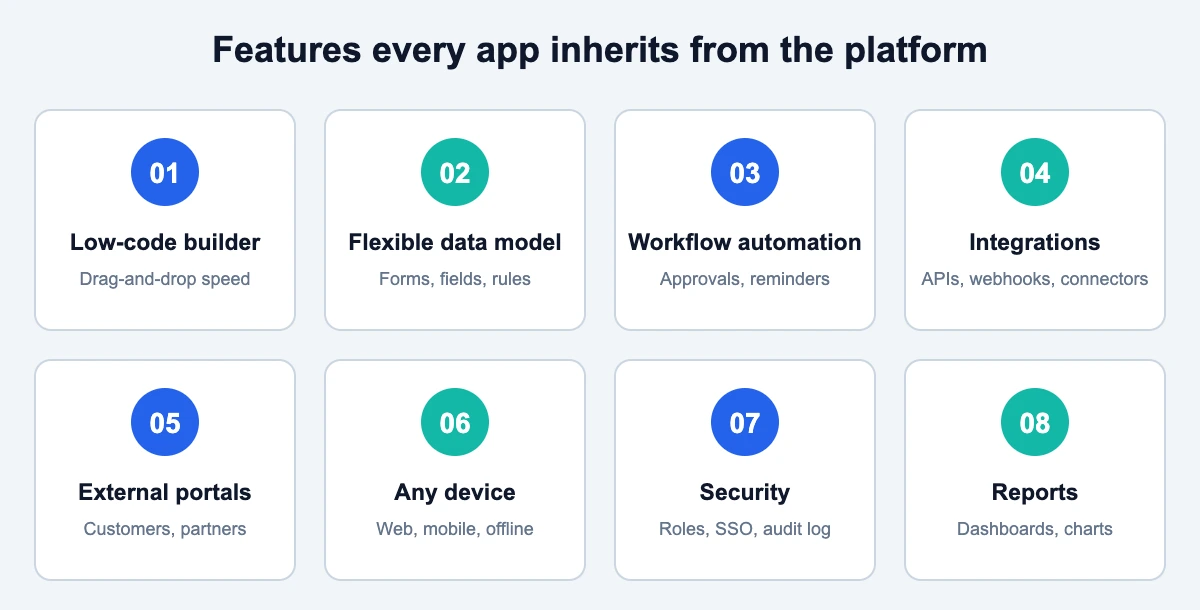
Low-code speed
Forms, views and processes are assembled in a visual drag-and-drop editor. A first working version reaches users in weeks, feedback becomes changes within hours, and a prototype is cheap enough to test an idea before a full rollout.
A configurable data model
Forms, fields, relationships between tables and validation rules can be added or changed without rebuilding the app. Conditional fields, calculated values, lookups into related records and scripts triggered by creating, editing or deleting data are all standard.
Workflow automation
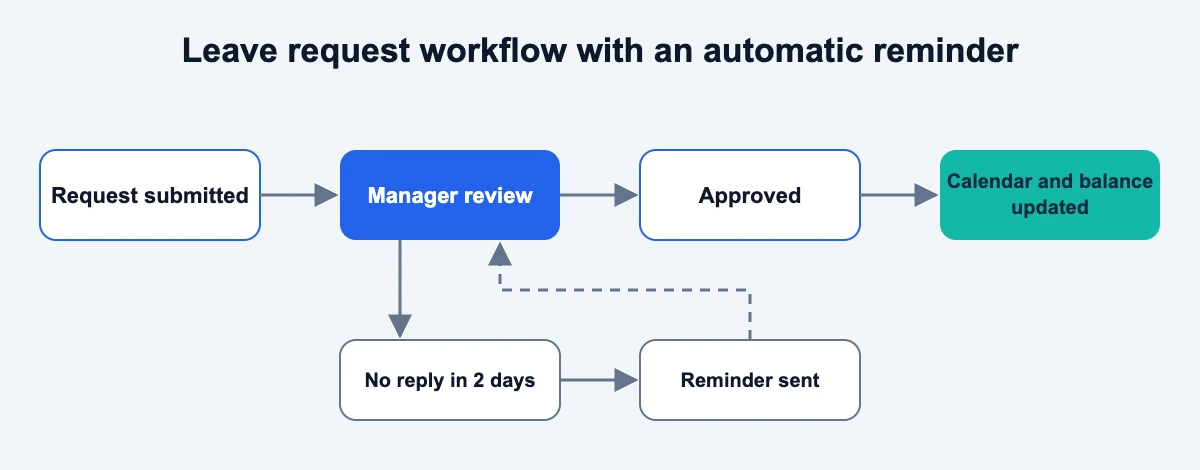
Approval paths, task assignment, deadline reminders, email and SMS notifications and scheduled jobs are built in. A leave request, for example, goes to the manager, updates the calendar and balance after approval, and sends a reminder if nobody answers in two days.
Integrations
The platform exposes and consumes REST APIs, handles webhooks and offers ready-made connectors to CRMs, accounting software, email, messaging tools and e-signature services. Data is entered once and lands where it is needed, with no re-keying.
Portals for customers, partners and suppliers
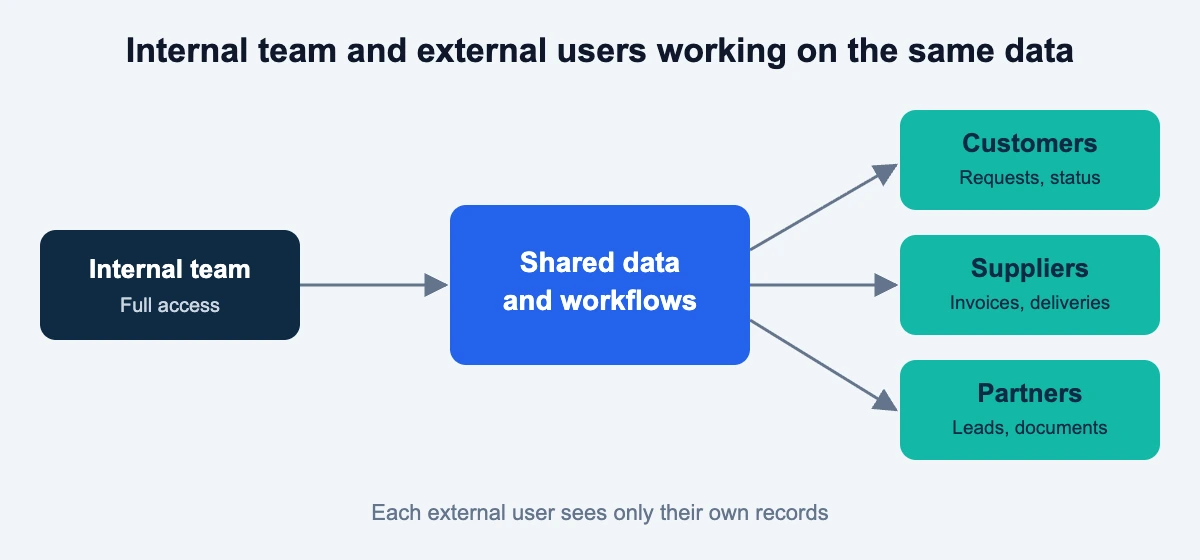
An application does not have to stop at your own employees. The platform lets us publish secure portals where external users work directly with your data and processes, without any access to your internal system.
Each group gets its own branded space. Customers submit requests and track their status, suppliers upload invoices or confirm deliveries, and partners register leads or download documents. Every external user signs in with their own account and sees only their own records, while the rules and workflows behind the portal are the same ones your team uses internally.
The result is fewer emails and spreadsheets, self-service available around the clock, and changes from external users that flow straight into internal processes.
Any device, even offline
Apps run in the browser, on phones and on tablets, adjusting to the screen, so there are no separate versions to maintain. Offline mode lets field staff enter data without a connection and synchronize it later. Device features such as the camera for scanning codes, location data and on-screen signatures are available too.
Security, roles and permissions
Access is controlled at the level of modules, forms, records and even single fields. On top of that come data encryption, single sign-on, two-factor authentication and a change log showing who modified what and when, which supports audits and GDPR compliance.
Reports and dashboards
Built-in reports, charts and management dashboards show the current state of sales, orders or workload with no export to spreadsheets. Users can filter, group and drill down to a single record, and reports can be shared or emailed on a schedule.
Extra features that come with the platform
Beyond the essentials, the platform adds capabilities we can switch on without extra development:
- Document generation. Quotes, contracts and invoices are produced as PDFs from templates filled with record data.
- File storage and attachments. Documents, photos and scans sit next to the records they belong to.
- Multi-language and localization. Interfaces, date formats and currencies adapt to each user’s language and region.
- Online payments. Portals can collect payments through popular payment gateways.
- Calendars and scheduling. Bookings, deadlines and meetings are shown in calendar and timeline views.
- Barcode and QR scanning. Useful in warehouses, service visits and event check-in.
- Separate environments. Development, testing and production are kept apart, so changes can be tried safely before they go live.
- Versioning and audit trail. You can see what changed in the app itself, not only in the data.
- Email-to-record and in-app notifications. Messages from customers create or update records automatically.
Hosting, scalability and maintenance included
The platform runs in the cloud, so infrastructure, backups, security patches and platform updates are handled by its provider. Your app scales from a handful of users to hundreds, and from thousands of records to millions, without being rewritten. You do not need your own servers or an IT team to keep it running.
Why this combination works
You get a solution shaped around your process by people who have done it before, built faster with the help of AI, and backed by a platform with years of proven features behind it. That means a shorter path to launch, a lower total cost of ownership and an app that can keep changing with your business.
Have a process that still lives in spreadsheets and email threads? Get in touch with 24hdeveloper and we will show you how it could look as an app.
