
Ask three people in a food plant what a recipe is and you will get three answers. The planner means the list of ingredients, the operator means the steps on the line, and the accountant means the cost of a kilogram. ERP vendors then add a fourth word, bill of materials, and a fifth, routing. If you are choosing a process manufacturing ERP, these words are worth getting straight, because the system you pick will make you describe your plant with them.
Three words, three different questions
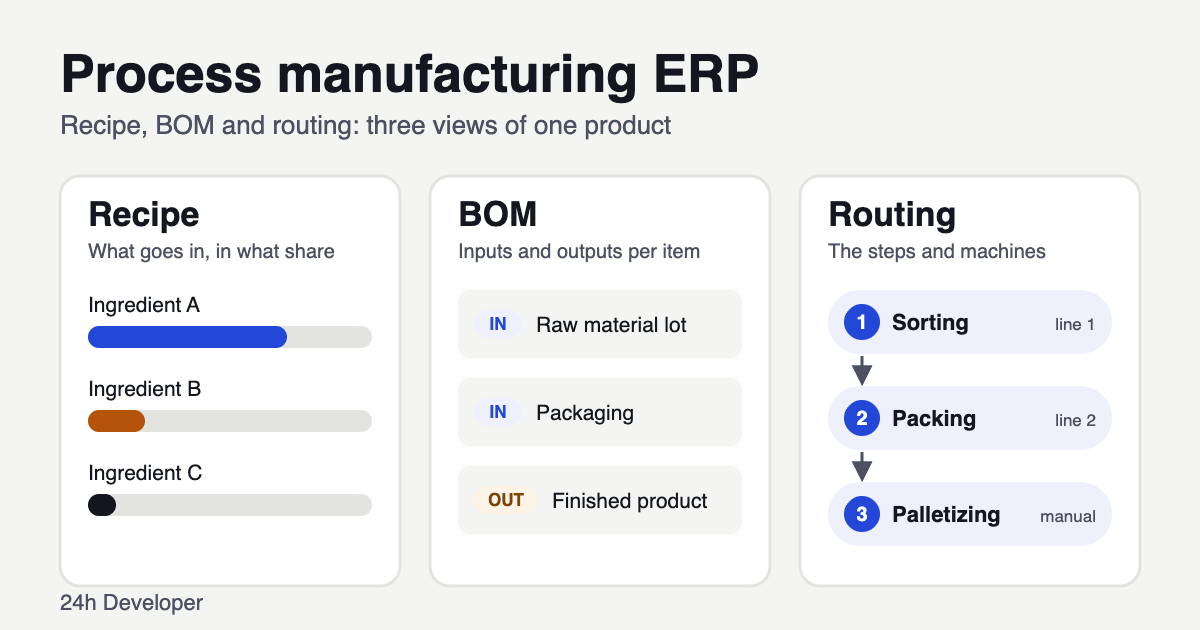
A recipe (or formula) answers: what goes in, and in what proportion? It scales with the size of the batch. Ten percent of ingredient B stays ten percent whether you make a hundred kilograms or five thousand.
A bill of materials (BOM) answers: what inputs and outputs belong to this item? It is a structured, versioned list, and in many systems it is the document everything else hangs on: material issue, planning, costing and stock.
A routing answers: how is the work done? It lists the operations in sequence, on which machine or by hand, and what has to finish before the next one can start.
In a small plant all three often live in one spreadsheet. An ERP separates them, and that is where most selection mistakes begin.
Where process manufacturing differs from discrete manufacturing
In discrete manufacturing you assemble distinct units: a chair, a tyre, a pump. The quantities per unit are fixed, and a BOM that says four screws per chair is simply true. In process manufacturing you mix, separate, cook, sort or cut. You cannot take the sauce apart again, output is measured in kilograms or litres, and the same input lot can give a little more or a little less than last time.
That difference shows up in the details: units of measure that change along the way, co-products and by-products, strict lot identity, and a yield that is a result to be recorded, not a number to be assumed.
Why a plain BOM is often not enough
A classic BOM multiplies a quantity per unit by the number of units. That works when you decide how many units to make and the inputs follow. In many processing plants it runs the other way. A lot of raw material arrives, you sort and pack it, and only at the end do you know what you got. Fruit varies by season, meat by trim, plastic by batch.
If the system insists on a fixed norm, people enter the norm and the real difference disappears into stock corrections. Billing, costing and traceability then rest on numbers nobody believes.
Two kinds of BOM for two kinds of production
A practical solution is to support two kinds of BOM side by side.
- Standard BOM. A norm per unit. Consumption is computed from the quantity produced and corrected when reality differs. This suits products with stable recipes, such as a tyre or a packaged blend.
- Process BOM. One production order starts from one input lot, and the operator enters what actually came out. Auxiliary materials, such as packaging, are tied to a basis output, for example per pallet. This suits sorting, trimming and packing.
Many plants need both, sometimes in the same building. A system that offers only one will push you to fake the other.
Routing turns the recipe into work
Once the BOM says what is made, the routing says how. Each operation has a sequence number, a mode (machine or manual), dependencies on other operations, and optionally a quality check or an outsourced step. When a production order is released, each operation becomes a work order that can be assigned, timed, inspected and confirmed on its own.
This is what makes a busy day manageable. You can see which step is waiting, how long packing really took, and what happened to the batch that failed inspection. Rework and replacement then become new work orders instead of edits to history.
Intermediate products, co-products and scrap
Sorted fruit that is not yet packed is an intermediate product. A good system gives it a lot, an owner and a place in the warehouse, so the next operation can pick it up and so nobody mistakes it for a finished good. Co-products and scrap need the same treatment, with their own outputs and reasons.
If you process goods for other companies, the owner of every one of these lots matters as much as the quantity. We cover that in ERP for toll manufacturing: 5 things your software must do.
What to ask a vendor
- Can I enter the actual yield of each input lot, and keep the norm only for planning?
- Does the system support both norm-based and yield-based BOMs?
- Are routing operations modelled with machines, sequence and dependencies?
- Do intermediate outputs become lots in stock?
- Can I version BOMs and routings without losing the history of past orders?
- How are rework, scrap and replacement handled?
If the answers are vague, ask to see them on one real order from your plant.
Where to start
Write down one product the way your shop floor describes it: the inputs, the steps, what comes out and what gets measured. Then try to describe it with the three words above. The gaps you find are your requirements.
To see how this looks in a working system, read about our ERP for manufacturing and processing companies, or tell us how your plant works.
