

Most system implementation mistakes are made in the first week, long before anyone writes a line of code. After three decades with business systems, first as a CIO and then for eighteen years running a company that rolled out CRM systems, I keep seeing the same one: a company automates a process that nobody has actually agreed on.
It rarely looks like a mistake at the time. The owner says, “We need an application for orders,” the project starts, and everyone is busy and optimistic. The trouble shows up weeks later, when the system works perfectly and half the team refuses to use it. The remedy is not a longer analysis. It is seeing a working version early, which is why I build a prototype within 24 hours of the first conversation.
The mistake: building around a process nobody can describe
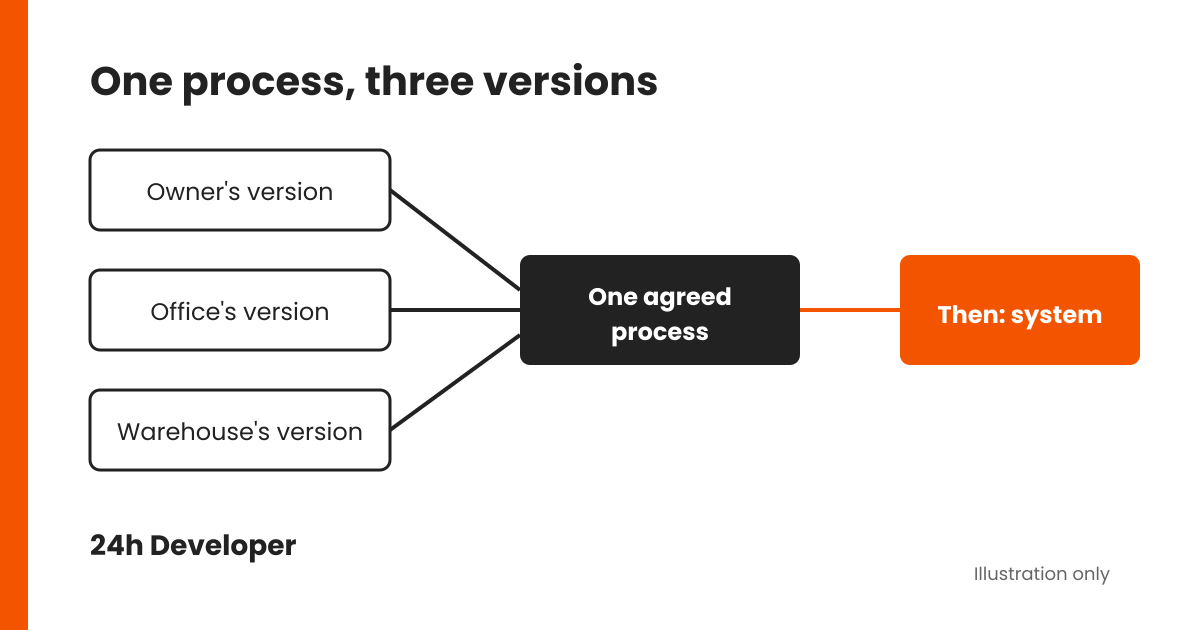
Ask three people in a small company how an order is handled and you will usually get three answers. The owner describes how it should work. The office describes how it works on a good day. The person in the warehouse describes the workarounds that keep things moving when it does not.
All three are true, and none of them is the whole picture. If a system is built from only one of those versions, it will clash with the other two. The people who have to live with the clash will quietly go back to their spreadsheet, their inbox and their phone, and the new system becomes one more place to type things in twice.
Why this hurts more in a small company
Large organisations have process owners, documentation and a change board. Small and medium-sized firms have people who know how things work because they have done it for years. That knowledge is valuable, but it lives in heads, notebooks and Excel files, and it is full of exceptions that feel too obvious to mention.
There is also less room for error. A small team cannot absorb a failed rollout the way a large company can, so a system that does not fit the daily routine is not a minor irritation. It costs time every single day until someone fixes it or abandons it. If you recognise your own company in this description, our article on the signs that Excel is no longer enough shows where these hidden processes usually pile up.
How to find the real process in one afternoon
You do not need a long analysis phase. You need a few hours with the right people and a willingness to hear things that are not in the official version. A practical way to do it:
- Pick one process, not the whole company. An order, a rental booking or a moving job is enough.
- Ask the people who do the work to walk you through the last three real cases, step by step, including where they had to ask someone or look something up.
- Write down every place where information is copied, retyped or sent by email. Those are the points where a system will help most.
- Mark the exceptions. Ask how often they happen and who decides what to do. Do not try to remove them yet; just make them visible.
- Put the result on one page and let the owner and the team read it together. Disagreements are the point of the exercise.
Agree first, then automate
The picture above is deliberately simple, because the idea is simple. Before a system is built, the different versions of a process have to become one version that the owner and the team accept. This is not bureaucracy. It is the cheapest moment to change anything, because changing a sentence on a page costs nothing and changing a finished application does.
Sometimes the exercise shows that the process itself should change. A step that exists only because of an old limitation can go. A manual approval that nobody ever rejects can be simplified. But I would resist the temptation to redesign everything at once. Automate the process people actually follow, remove the clearest waste, and improve the rest after the first version is in use.
Let the people who do the work see it early
The second half of the cure is showing the result early. A working prototype tells you far more than a specification, because people react to something they can click. A person who would never read a ten-page requirements document will tell you within two minutes that a field is missing or that the order of the screens is wrong.
This is the reason my offer is built the way it is. Within 24 hours of our conversation you get a working prototype of your process. Then follow 14 days of testing, when your team tries it on real cases and tells me what does not match the way they work. Only after that do you decide about the full implementation. The agreed process on your one page becomes the specification, and the prototype is the first honest test of it. You can read how the 24-hour prototype works and what you actually get, and CRM or a custom application compares the two options if you are still deciding.
Where to start
If you are planning a system, spend the first afternoon on the process, not on the features. Choose one process, talk to the people who do it, and put one agreed version on paper.
Then bring that page to a short conversation with me. I will turn it into a working prototype within 24 hours, your team tests it for 14 days, and you decide with real experience instead of promises. Everything that comes after becomes faster and more accurate.
