
Most companies spend more time choosing a car than choosing the software that runs their daily work. The good news is that the questions before ordering software are few, and you can answer them yourself in an afternoon, before a single offer lands in your inbox. After thirty years with business systems, as a CIO and later as the owner of a company that deployed CRM systems, these are the five I would insist on. The fourth one, seeing a working prototype, is the one that makes the other four much easier to answer, and it is the reason I built my own offer around a prototype delivered within 24 hours.
1. What problem are we solving, in one sentence?
If you cannot say it in one sentence, the project is not ready. “We need an app for orders” is a wish. “Orders arrive by phone, email and messages, and we lose track of what was promised to whom” is a problem. A clear sentence lets everyone judge later whether the system worked.
Add one more detail: roughly how much time the problem costs today. Estimate it honestly from your own week, without borrowed statistics. That number is your reality check when someone proposes a bigger scope than the problem deserves.
A useful test is to ask whether a new colleague could understand the problem from your sentence on their first day. If they could, the people building the system will understand it too, and so will the people who later have to decide whether the result is good enough.
2. Who will use it every day, and have they been asked?
The owner often orders the system, but the office, the warehouse or the drivers use it. If they have not been consulted, expect resistance or, worse, quiet workarounds. Talk to the people who do the work and ask them to describe the last three real cases. Our article on how an order management system rollout works step by step shows where their input matters most.
3. Who owns the data, and can I take it with me?
Your customers, orders and prices are the most valuable thing in the system. Ask in plain words: where is the data stored, who can access it, and can I export all of it in a readable format at any time? A good answer is short and specific. A vague one is a warning. It is much easier to ask this before you start than when you want to leave.
Ask the same of any provider you talk to: what happens if you decide to leave, and in what form do you get your information back? The answer tells you a lot about how the relationship is going to work. In my experience, owners who ask this early are treated as partners, and the conversation about everything else becomes easier.
4. Can I see something working before I commit?
Documents describe software; they do not prove it. The most reliable way to answer every other question on this list is to see a working prototype built around your own process, with your own data fields and your own way of naming things. Not a demo of someone else’s product, but your orders, your customers, your workflow on a screen.
This is exactly how I work. Within 24 hours of our conversation you get a working prototype of your process. Then comes a test period of 14 days, when your team uses it on real cases and tells me what is missing or wrong. Only after that do you decide whether to go for the full implementation. If the prototype does not convince you, you have lost very little, and you know more about your own process than you did before.
A prototype also changes the quality of the discussion. Instead of arguing about what a feature might do, your team reacts to a real screen, and small corrections made at this stage are quick. They prevent the larger corrections that otherwise appear after launch. For the details of how this fits into a single day, read how the 24-hour prototype works and what you actually get.
Ask the same of any provider you talk to: can I test something real before I sign, and what happens if I decide to leave? The answers tell you a lot about how the relationship is going to work.
5. Who will look after it next year?
Systems need small changes: a new field, a new report, a new product line. Ask who makes those changes, how quickly, and what happens if the person who built it is unavailable. Is the solution documented well enough that someone else could take it over? If you are also wondering what drives the price over time, our overview of what a custom business application costs explains the main factors.
Write the answer to this question down with a name next to it. Software that belongs to everybody in general usually belongs to nobody in particular, and that is when small problems start to grow. A named person, even part-time, keeps the system useful as the business changes.
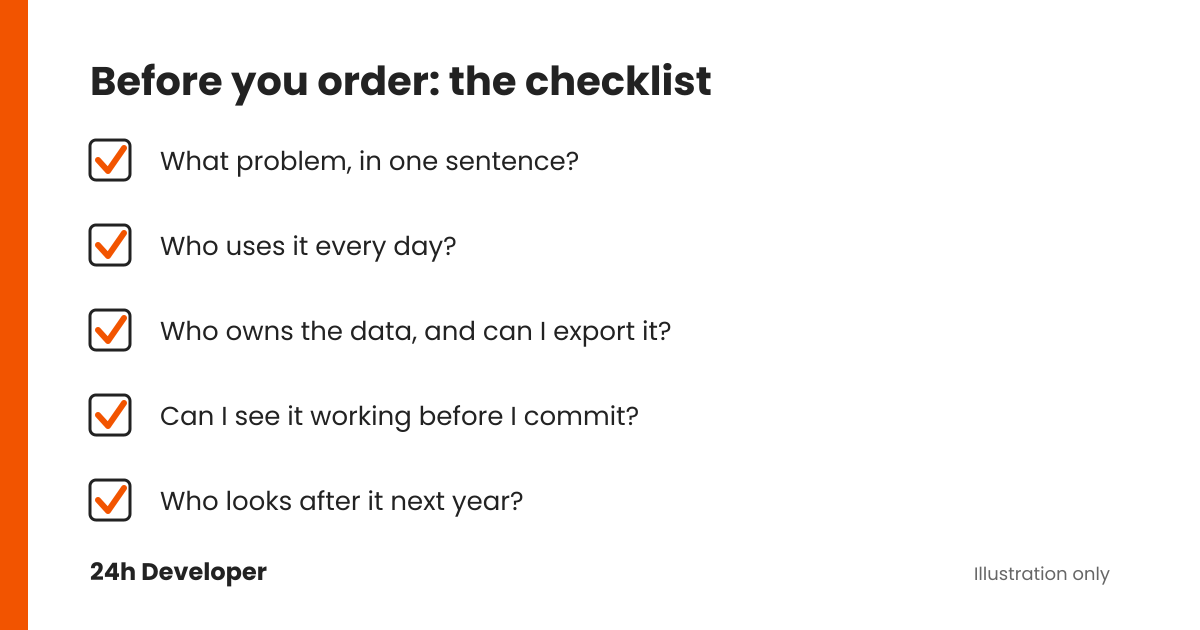
Using these questions before ordering software
You do not need all five answers to be perfect. You need to know which ones are missing. Write the five questions on a single page, answer what you can, and bring the rest to a conversation with whoever will build the system.
The quickest way to fill the gaps is to stop discussing and start looking at something real. Tell me how your process works today, in a short conversation, and I will turn it into a working prototype within 24 hours. You test it for 14 days with your team, and then you decide, with real experience instead of promises.
